E-Ticketing vs Paper Tickets: What a Paper Ticket Costs
A paper ticket costs you three ways, and none of them shows up as a line item. On 12 trucks the arithmetic comes to roughly 500 office hours a year and 2 weeks of cash you have already earned.
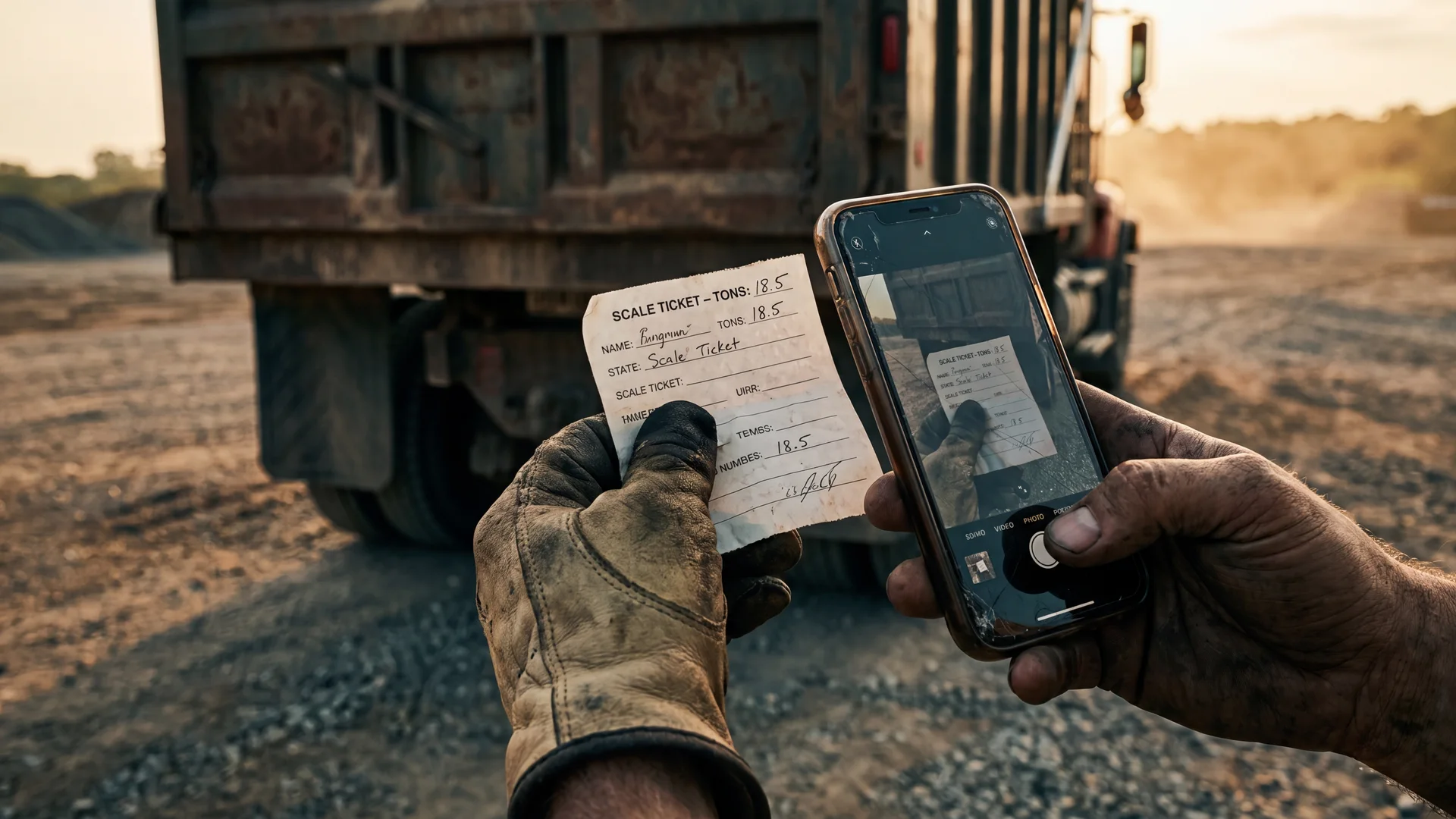
Take an operation with 12 trucks running 5 loads a day each. That is 60 paper tickets a day, 300 a week, and about 15,000 a year, each one handled by a driver, a dispatcher, and someone in billing. The arithmetic below uses that operation and states every assumption, so you can put in your own numbers.
What is e-ticketing
E-ticketing replaces the paper scale ticket with a digital record captured at the truck and attached to its load, visible to dispatch, the office, and the customer at the same moment. The driver photographs the ticket in the app at the scale, a third-party driver without the app texts a photo of it, or the scale house sends the ticket electronically. In every case the ticket stops having to ride back to the office before anyone can use it.
Handling time
- 60 tickets a day at about 2 minutes each to collect, sort, key, and file: 2 hours a day
- 250 working days: 500 hours a year, about a quarter of a full-time position
- Time spent chasing late, wrong, and missing tickets is on top of that
2 minutes is the handling assumption behind Tread’s ROI estimate, and it is conservative for a ticket that gets touched by a driver, a dispatcher, and a billing clerk before it is filed.
Loads that never get billed
Some tickets do not make it back. They blow out of a cab, get left in a truck that moves to a different job, or sit in a glovebox until the customer has already been invoiced. If one ticket in 200 goes missing, that is 75 loads a year on this operation. At $150 a load, that is $11,250 hauled and never billed, before counting the disputes where a customer questions tonnage, nobody can produce the ticket, and the line gets written down. If you have never counted, run one month: loads dispatched against tickets that reached billing.
Cash you have already earned
Every day between the load delivering and the invoice going out is a day the money sits in the customer’s account instead of yours. When invoicing waits on paper coming back from the field, that gap runs about 2 weeks. One producer described it to us as waiting for the previous week’s tickets to arrive, then sorting and verifying them, before an invoice could start. On $200,000 a month of hauling, a 2-week lag means roughly $100,000 is always earned and not yet invoiced. When the ticket exists digitally the moment it is captured, delivered loads can go on an invoice the same day.
Day to day
For the driver, one habit: photograph the ticket before pulling away from the scale. The app saves the photo without signal and syncs it later, so a pit with no coverage is not an excuse. Third-party drivers who will not install anything text the photo to a number; the training is a phone number taped to the dash.
For the office, the 2 hours of keying becomes a review of exceptions. AI reads the photo and fills in the load record, a person approves it, and anything the AI is unsure about is flagged. Each ticket is checked against its load, so a short load or a duplicate ticket shows up the same day. Delivered loads roll into draft invoices that sync to QuickBooks or export to Sage 300, Vista, Foundation, or Spectrum.
Switching
Less than an IT project. Tread’s team loads your trucks, third-party haulers, customers, and rates, and operations go live in weeks rather than months. Drivers need the app or a phone number. The harder change is in the office: stop accepting paper at month end. Every ticket that still arrives on paper is a ticket someone matches by hand, and the 500 hours only go away when the paper does.